8/31/2026 | 2 min read
Mastering Shopify Reorder Points & Safety Stock: The Ultimate Purchasing Formula
Stop guessing when to reorder inventory on Shopify. Learn the exact mathematical formula for reorder points, lead time buffers, and daily sales velocity to eliminate stockouts and cash waste.
The Hidden Cost of Guesswork in Purchasing
Every e-commerce merchant faces the double-edged sword of inventory management: order too late and you suffer out-of-stock lost revenue; order too early or too much and you tie up critical working capital in dead inventory.
The solution is not gut feeling—it is a disciplined, mathematical approach to Reorder Point (ROP) and Safety Stock planning.
The Core Reorder Point (ROP) Formula
The standard reorder point formula is:
Reorder Point (ROP) = (Average Daily Sales × Vendor Lead Time) + Safety Stock
Breaking Down the Variables:
- Average Daily Sales (Sales Velocity): The average number of units sold per day over a representative window (typically the last 30 to 90 days).
- Vendor Lead Time: The number of days between placing a Purchase Order and the physical arrival/receiving of goods at your warehouse.
- Safety Stock: The buffer units maintained to protect against unexpected sales spikes or supplier delivery delays.
How to Calculate Safety Stock Scientifically
For high-turnover SKUs with fluctuating demand or unreliable supplier lead times, calculating safety stock with variance delivers maximum protection:
Safety Stock = (Max Daily Sales × Max Lead Time) - (Average Daily Sales × Average Lead Time)
Real-World Store Example:
Suppose you sell an Organic Cotton T-Shirt on Shopify:
- Average daily sales: 12 units/day
- Peak daily sales during promos: 20 units/day
- Average vendor lead time: 14 days
- Maximum vendor lead time (shipping delays): 21 days
Safety Stock = (20 × 21) - (12 × 14) = 420 - 168 = 252 units
Lead Time Demand = 12 × 14 = 168 units
Reorder Point (ROP) = 168 + 252 = 420 units
When your Shopify inventory count drops to 420 units, it is time to generate a purchase order for that supplier.
How PODesk Automates Reorder Calculations for Shopify
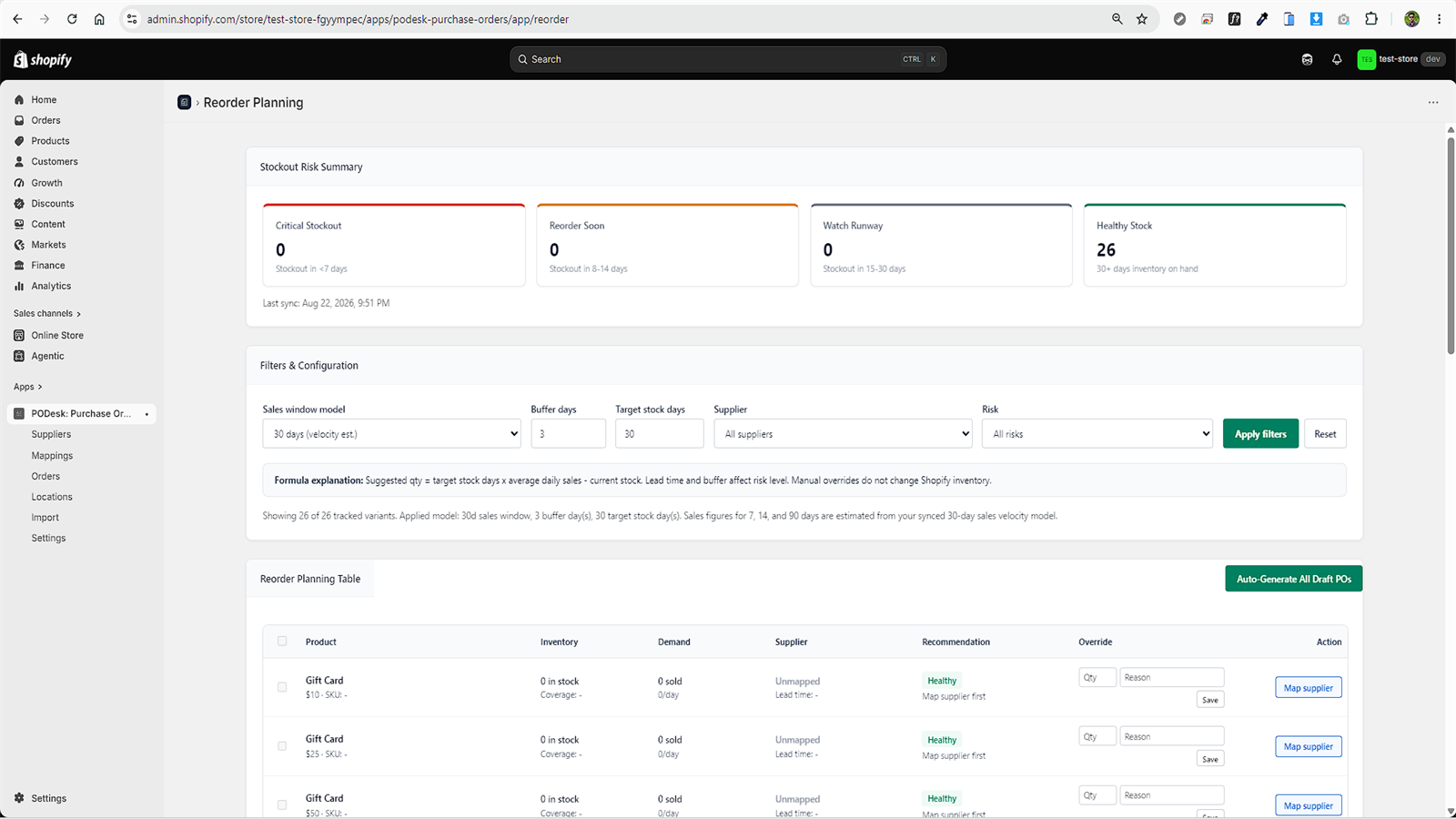
Manually computing formulas in spreadsheets for hundreds of SKUs every week is exhausting and prone to human error. That is why PODesk performs continuous reorder intelligence directly against your Shopify catalog:
- Automatically calculates 30-day daily sales velocity per SKU.
- Applies your vendor-specific lead times and customized safety buffers.
- Categorizes products into OK, Reorder Soon, and Critical Risk.
- Generates a suggested reorder quantity that you can review and convert into a finalized PO in 1 click.
Automate Your Reorder Planning Today
Install PODesk from the Shopify App Store for free and let the algorithm do the heavy lifting.
Get PODesk on Shopify App Store →Related Tools & Guides
Comments
0 replies- No comments yet. Be the first to share your thoughts.